
Prince Edward County Tax Record Fields
Prince Edward County splits tax duties between two offices. The Commissioner of the Revenue maintains the real-estate ownership records and the assessment data behind the tax roll. The Treasurer collects the taxes. That office also runs the bill, payment, and balance inquiry. Payment status is a Treasurer question. So is any balance calculated to a chosen date. Neither record replaces the other, and a GIS map is not a tax bill any more than a tax bill is a deed.
| Field | What It Shows | Where |
|---|---|---|
| Owner and parcel key | County ownership-roll entry tied to a real-estate parcel | Commissioner of the Revenue |
| Land / improvement / total assessment | Assessment fields to request; live card labels were not captured | Commissioner |
| Tax bill | Real-estate charge and account details | Treasurer Public Inquiry |
| Payment history | Prior payments and current status shown by the inquiry | Treasurer |
| Projected balance | Penalty and interest calculated through an entered date | Treasurer inquiry |
No field-by-field parcel card or local exemption list appears online. Do not assume a homestead, senior, or veteran field shows up on the real-estate account. The Commissioner lists a disabled-veteran exemption. It applies only to personal property. That is not proof of a real-estate break. Ask which rule applies to the specific parcel and tax year before comparing taxable amounts.
Prince Edward County Treasurer Search Routes
The Treasurer's help page documents three routes to a real-estate account. A GPIN is the Tax Parcel ID#. Keep its spaces. The street search is unusual but handy. Enter only the street name, skip the house number, scan the matches, and note that a blank projected date simply runs the penalty-and-interest calculation from today.
| Control | What to enter | What follows |
|---|---|---|
| Account Number | Number at upper left of a tax bill | Search the selected account |
| GPIN Number | Tax Parcel ID with the right spaces | Search the parcel's tax account |
| Street Name | Street only, no house number | Open a paged list of matching accounts |
| Projected Date | Date for balance calculation, optional | Show calculated penalty and interest through that date |
| Description / Map Number | Toggle on the selection screen | Compare the returned parcel identifier |
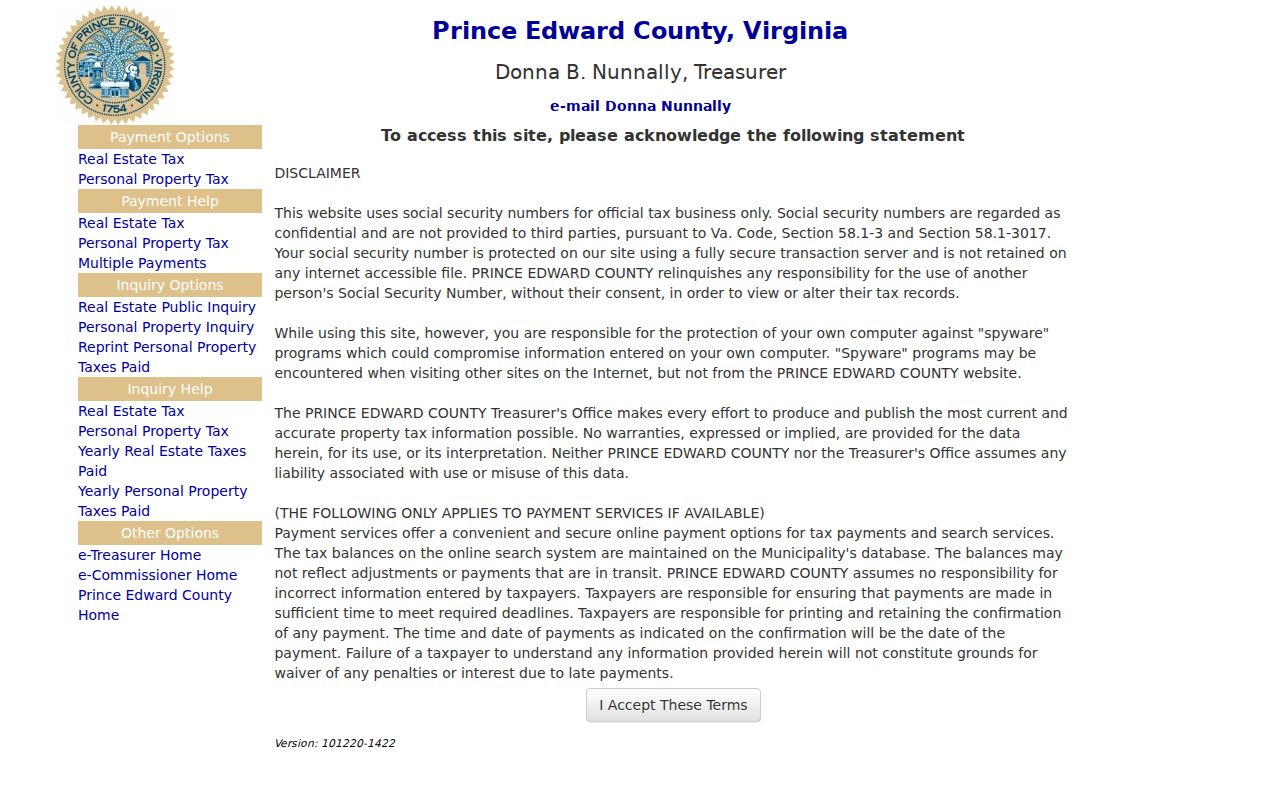
Choose a row and press Select. That opens the payment history. Page numbers may reveal more street matches. Previous returns you to the selection screen, so save the date used and whether the result showed a description or map number, because a projected balance is a calculation input rather than a historic bill snapshot. The Real Estate Public Inquiry screen states its access terms before any search begins.
A closing balance deserves a paper trail. Keep a copy of the result, and ask the Treasurer to confirm the amount for the date you need.
Prince Edward County Reassessment Cycle
Prince Edward County uses a four-year general reassessment. The goal is fair market value, with similar property taxed on equal terms. The cycle does not freeze a parcel. Boundary adjustments, divisions, zoning changes, court orders, and new construction can all change the record, and assessors make field visits to value new improvements for taxation.
The county announced a 2025 reassessment. Notices went out by mail, and those appointment dates are now history. Rely on the current county notice for any future review. A notice belongs to its assessment year, so preserve it with the parcel ID and the date received. If a card seems wrong, start with facts. Ask the Commissioner to check acreage, a parcel split, an improvement, or the owner information before anything else.
The county reassessment page posts current instructions. The 2025 notice is history, not a reusable calendar. The county release treated property facts and comparable sales as evidence. No single sale promises a value for every parcel.
Opening a Prince Edward County Tax Bill
The Treasurer's real-estate inquiry answers amount-due and payment-posted questions. Start with the account number or GPIN. If neither is handy, search by street name alone. Compare the description or map number on each result before picking the parcel. The Treasurer documents that street route, which makes it a safer fallback than guessing a house-number format. When more results are available, review the later pages too.
- Choose Account Number, GPIN Number, or Street Name.
- Enter the bill's number exactly, preserve GPIN spaces, or enter street name without a street number.
- Review every result page and toggle the description or map number to match the parcel.
- Select the record and read the payment-history and detail screens.
- Enter a projected date only when you need the balance calculated through that date.
- Assessed value
- The county's value used for real-estate taxation, not a sale quote.
- Levy
- The charge billed for a tax period; verify it on the bill.
- Projected date
- The date used to calculate penalty and interest, not a saved past bill.
- Tax lien
- A legal claim that must be checked in the proper tax and land-record sources.
Prince Edward County Tax and Deed Records
A tax account can show a balance or a paid status. It is not a full lien or title search. Keep three questions apart in a property review. The first covers what tax was billed and paid. The second asks whether an instrument or judgment was recorded. The third is whether a tax sale or foreclosure event was documented. The Treasurer's delinquent-tax resource covers the first. Recorded instruments and cases belong to the Circuit Court Clerk's land index and court files.
Never call a parcel clear from a web result. Ask the Treasurer to confirm the account, year, and status, then check the Clerk for the recorded instrument or case, because a balance screen replaces neither a receipt nor a court record.
Appealing a Prince Edward County Assessment
A Prince Edward County owner who thinks an assessment misses the facts of the property has a defined route to challenge it. The Commissioner of the Revenue publishes the review and appeal steps on its reassessment page. Gather the paperwork before asking for a review. That means the current assessment notice, the parcel identifier, comparable property data, and any record of a material condition. A map can pinpoint the parcel. It cannot settle the value question. Likewise, a deed may show a transfer price. That price alone does not prove the assessment wrong.
Dates deserve care here. The county's published 2025 notice listed hearing dates that have already passed. Treat them as history rather than a live filing deadline. Check the current notice. Or call the Commissioner at 434-392-3231 for the active review calendar and the required submission method.
Keep the appeal timetable and the Treasurer's payment deadline separate. The annual real-estate tax due date is December 5. Filing a valuation appeal does not change a bill or pause the payment obligation. The official Prince Edward County reassessment page preserves the county's published instructions.
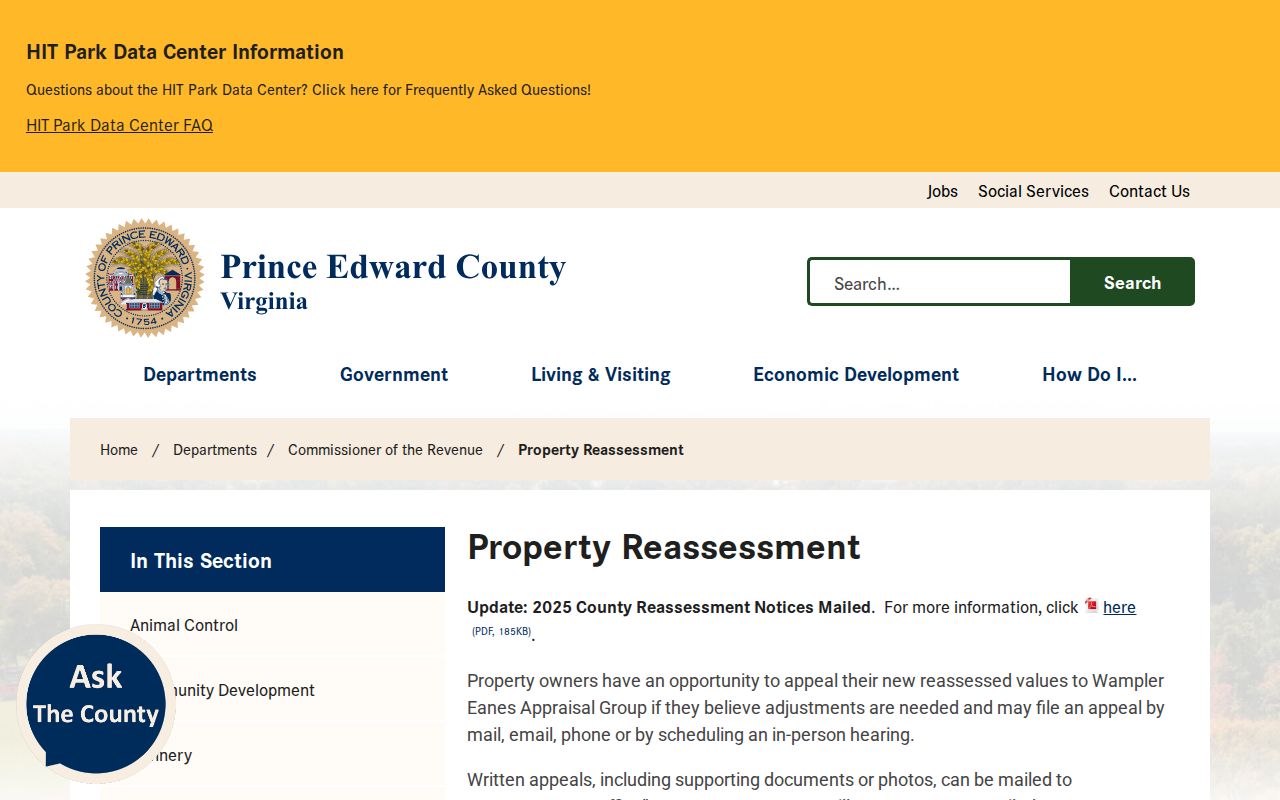
The county's 2025 reassessment notice documents that appeal cycle, not today's deadline. Rely on the latest county notice for current appeal dates and filing instructions.
Two remedies appeared in the 2025 materials. One was a Board of Equalization route. The other was a Circuit Court remedy under Virginia Code §58.1-3350. Both calendars from that year have run their course. A property owner should instead follow the deadline, form, and evidence rules stated on the current assessment notice. Do not lean on a prior year's schedule.
On evidence, the county's appeal material pointed to comparable-sale data, property details, and corrected statistics. Those items show why an assessment is not uniform with similar property. They can also show that it exceeds fair market value.
Use the current notice. The 2025 hearing dates and February 21 submission deadline are historical. Ask the Commissioner or review the live county reassessment page for the current appeal route and deadline.
An informal correction starts with the parcel and the disputed field. A formal appeal calls for the notice, comparable sales, photos, and measurements. It also requires proof of every delivery. Virginia Tax lays out the substantial-evidence and fair-market-value concepts. Local filing instructions control the Prince Edward County process, though. See the Virginia Tax appeal explanation for the statewide standard.
Prince Edward County Real-Estate Tax Date
The Treasurer sets December 5 as the real-estate tax deadline. Confirm the current bill and payment status through the inquiry function. You can also check with the office itself. A projected date can compute penalty and interest as of a chosen day. That helps with a closing estimate. It does not save a historical bill for that date.
Keep the pieces of the lookup together. That means the tax year, the account or GPIN, the projected date, and the balance shown on the detail screen. For a paid amount, use the Treasurer's payment-history or yearly paid-taxes function. Do not treat a balance screen as a receipt. Compare these Prince Edward County property tax records by account and billing period.
Requesting Prince Edward County Tax Records
Prince Edward County splits its property tax trail between two offices on the same floor. For an assessment card or ownership-roll question, contact the Commissioner of the Revenue at 124 N. Main Street, second floor, Farmville. You can also call 434-392-3231. For a bill, payment history, or delinquency, contact the Treasurer at that address. Or call 434-392-3454. Each office keeps a different part of the record, so the distinction matters.
A written request should identify the parcel's GPIN or account. Include the situs, the tax year, and the exact record sought. Ask for an estimate when staff must search or copy older material. Virginia FOIA requires enough detail to identify the public record. Exemptions and other laws still apply. The online Treasurer system also links yearly real-estate taxes paid and paid-tax reprints. Use those functions whenever a payment history or receipt is the question.