
Prince Edward County Current Owner Record
Prince Edward County's Commissioner of the Revenue maintains the real-estate ownership roll, as the office page explains. The county's public link opens the e-Commissioner system. Its search screen shows no last-updated field. Ask for the record by GPIN, account, or situs. Preserve the assessment year and any update date the office provides. Read the owner field together with the parcel key, legal description, and deed reference rather than trusting the name alone.
| Owner field | County name or entity string; exact label is not confirmed. |
|---|---|
| Mailing address | Destination for notices, which may differ from the land's location. |
| Situs | Physical parcel address used to identify the property. |
| GPIN / account | Parcel and billing keys used to cross-check county records. |
| Assessment year | Year associated with value; not a verified owner-update timestamp. |
| Latest deed | Recorded transfer and date to compare with the roll entry. |
A Prince Edward County record can list a trust, LLC, estate, or fiduciary as owner of record. Such labels hide plenty. They say nothing about occupancy. That matters for interpretation. A mailing address helps separate records, but it is no verified residence; when the public card lacks a field, ask the Commissioner instead of filling the gap with a guess.
The county's Real Estate Records application is the main online starting point for a parcel lookup.
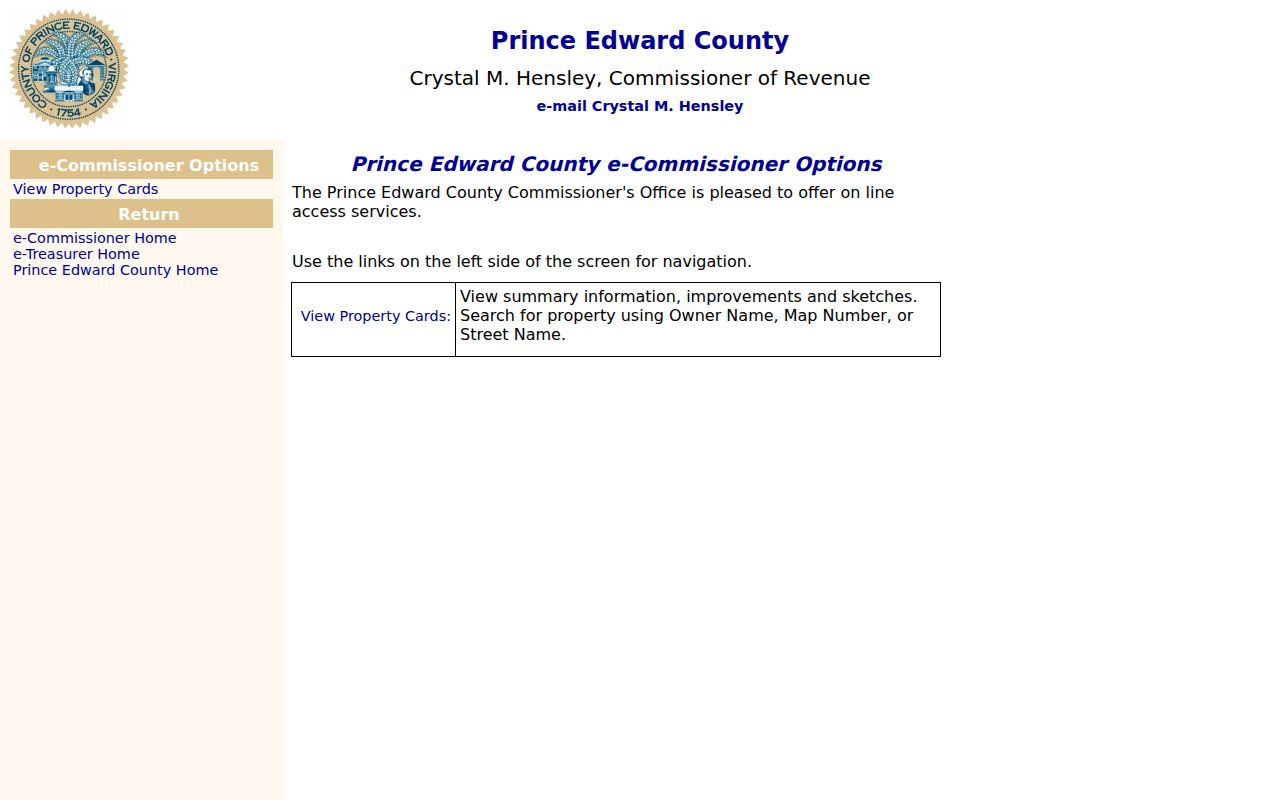
The application opens on a landing frame. That confirms the route into Prince Edward County property records, not the fields a live parcel card displays.
When a Prince Edward County Owner Changes
A transfer becomes part of the land-record trail only when the Circuit Court Clerk accepts an instrument for recording. The assessment roll works on its own clock. The new name may not appear there right away. Prince Edward County publishes no standard gap between recording and a roll update. So never assume a fixed lag. If the deed is recorded but the Commissioner page still lists the prior owner, cite the instrument number, book and page, recording date, and GPIN when asking the office to reconcile the roll.
Entities complicate the picture. A trust, company, estate, or co-ownership arrangement can make a name change hard to spot on a parcel card. Read the granting clause. Check the grantee vesting too. An abbreviated display label is no substitute for the deed itself, and a transfer made through an estate or court order deserves a closer look at the authority and legal description in the source instrument.
The assessment roll and the deed index are separate records. They change at different times. That gap is normal. A deed's recording date remains the best marker of title freshness among local Prince Edward County sources. The county has not published a nightly, monthly, or closing-to-roll update interval for its tax roll. When a recent grantee is missing from the Commissioner record, compare the instrument date with the recording date, then ask whether the roll is pending an update.
Do not confuse the two dates. The assessment year is one thing. The date a particular owner name was entered is another. A current assessment can still show a prior owner after a recent transfer, while the newest deed may list a grantee the tax roll has not caught up with yet. Neither system has failed. Save both citations and ask the Commissioner to confirm the public roll for that parcel.
Confirming a Prince Edward County Owner
Start with the Virginia SRA site. Search for the latest deed under the current grantee name and locality, and note what the result returns: parties, date, document type, and a book/page or instrument number. Coverage of local fields varies. Open the full entry before drawing conclusions. If the roll and deed disagree, check that the parcel descriptions match and that the new deed was recorded in Prince Edward County. The SRA index is not the official instrument itself. Image access may require a subscription authorized by the Circuit Court Clerk.
- Capture the Commissioner owner field and GPIN for the parcel.
- Search the current name as grantee in Virginia SRA and save the result citation.
- Inspect the deed image or request a copy; verify the legal description and recording date.
- Call the Commissioner if the roll and the newest deed show different names or dates.
- Owner of record
- The person or entity named in an official ownership record.
- Vesting
- The way a deed describes the grantee's interest or capacity.
- Grantee
- The party receiving the interest in a recorded instrument.
- Registered agent
- A contact named in a business filing, not necessarily the land's owner or occupant.
For deed mechanics, see Prince Edward County deed records.
Entity Names on the County Roll
When the owner of record is a company, copy the name exactly as it appears on the deed and the county roll before searching the Virginia SCC database. A registered agent helps. So does a principal office. Neither proves that person owns the parcel. For a trustee, executor, administrator, or estate name, compare against the actual deed or court order that transferred the land.
The Clerk's office holds estate records and wills. The Library of Virginia's Chancery Index can surface heirs, plats, land divisions, and related material. A public roll entry does not expose every private agreement or beneficial interest behind a Prince Edward County parcel. Do not guess. If the recorded instrument stays silent about who sits behind a trust or entity, the honest answer is that the record does not say.
Prince Edward County Owner Alerts
VADeed Alert is a free Clerk-linked notification service. It emails a notice when a filing matches a name. A Tax Map/Parcel ID works too. That makes it handy for watching new activity tied to a current owner record. It cannot verify what an instrument says, though. It will not trace the full past chain of title. Read the actual deed or release behind any alert before drawing conclusions.
Alerts can also slip. A filing goes unnoticed sometimes. The name or parcel key differs from the form used at recording. Keep the GPIN and deed citation with your signup details. Check the county's real property records whenever a notice arrives.
Farmville Owner and County Records
A Farmville mailing address does not settle which office holds the record. The town straddles the Appomattox River into Cumberland County. So confirm the deed's county before calling the Prince Edward Commissioner. Check the corporate-limit context too, since it affects the parcel. ZIP 23901 is postal geography only. A GIS map can help locate the parcel and the town line. But the written county designation and the recorded legal description should guide the next step of a property search.
Farmville's Town permits and zoning files stay municipal. On the Prince Edward side, though, ownership sits in the Commissioner's roll. Tax accounts sit with the Treasurer. Land records live in the Circuit Court. Keep those record roles straight when matching a current owner to a permit file.
Checking a Prince Edward County Roll Update
The assessment year and the recording date make useful comparison points. Neither one reveals the exact day the county changed the owner field. Ask the Commissioner about a recent instrument. Has it reached the current public roll? Request the update date if one is available. The county publishes no typical lag between a recorded sale and a roll change.
If the display still lists the prior grantee, keep the older and newer deed citations together. That keeps any follow-up on the property records clear. Do not guess at a refresh schedule for the tax roll.
Reading a Prince Edward County Owner Address
A mailing address can help tell two parcels apart. It also shows where a tax bill gets sent. But it is not always the owner of record's home. It may not be a phone contact or the situs of the land itself. Virginia's Address Confidentiality Program gives eligible protected participants a substitute mailing address. Sealed court records, protected vital records, and certain voter details likewise stay limited under their own rules. That protection sits separate from the property records themselves.
Owner and occupant differ. Use public owner information for a property matter or record check. Do not use it to locate, expose, threaten, or harass anyone.
For assessment questions, contact the Commissioner at 434-392-3231, P.O. Box 446, Farmville, VA 23901. For a recorded transfer, call the Clerk at 434-392-5145. Each office can verify its own deed and tax records, though neither certifies a full title opinion.