
Prince Edward County Deed Types
Prince Edward County property records held by the Circuit Court Clerk cover more than deeds. The Clerk's recordings include plats, estate records, judgments, financing statements, wills, and marriages. A deed records a conveyance or a stated interest in land. It does not erase the other instruments around it. So read each document as part of one connected record. The record includes the deed type, the parties, the date, the legal description, any exceptions or reservations, and the references to prior deeds. Virginia Secure Remote Access helps you find the index entry itself. Confirming the full text still takes a copy. A counter inspection at the Clerk's office also works for that.
| Deed Type | What It Does | Common Use |
|---|---|---|
| Deed of conveyance | Names the parties and land interest conveyed in the recorded instrument | Confirm a transfer and read its description |
| Quitclaim deed | Conveys whatever interest the grantor holds without a broad title promise | Review family transfers or a correction |
| Deed of trust | Creates a security interest; it is not the ownership deed | Check loan-related encumbrances and later releases |
| Fiduciary or estate instrument | May document a transfer by an executor, administrator, or trustee | Trace a death or trust-related conveyance |
| Plat or easement | Maps lots or records a right affecting land | Read boundaries, access, and subdivision context |
Common instruments each play a distinct role. A deed of trust secures a debt. A later certificate of satisfaction or release records the payoff as its own separate event. One caution applies here. A lender may vanish from an assessor card. That does not prove the security instrument was ever released of record. When a question turns on a claim affecting land, judgments, lis pendens, and financing-statement records deserve the same attention as the deed. The Clerk's menu labels for instrument types may vary. Search by party and date rather than relying on one category name.
Prince Edward County Index and Image Dates
The online land-record service has two separate starting points. The index reaches back to January 1, 1916. Images begin January 1, 1940. Those dates describe the online service only, not the county's land records themselves. Prince Edward deed books actually begin in 1754. Older books and general indexes remain available through the Library of Virginia and the Clerk. Before concluding an image is missing, check whether the year falls before 1940 or outside the online index entirely. The gap usually explains it.
| Online index | January 1, 1916 forward, as stated by the local Clerk. |
|---|---|
| Online images | January 1, 1940 forward; verify the particular instrument and its access state. |
| Historic deed books | Library of Virginia catalog lists books beginning in 1754 and continuing through Book 47, ending in 1902. |
| General indexes | Grantor and grantee indexes cover 1754-1916 on microfilm. |
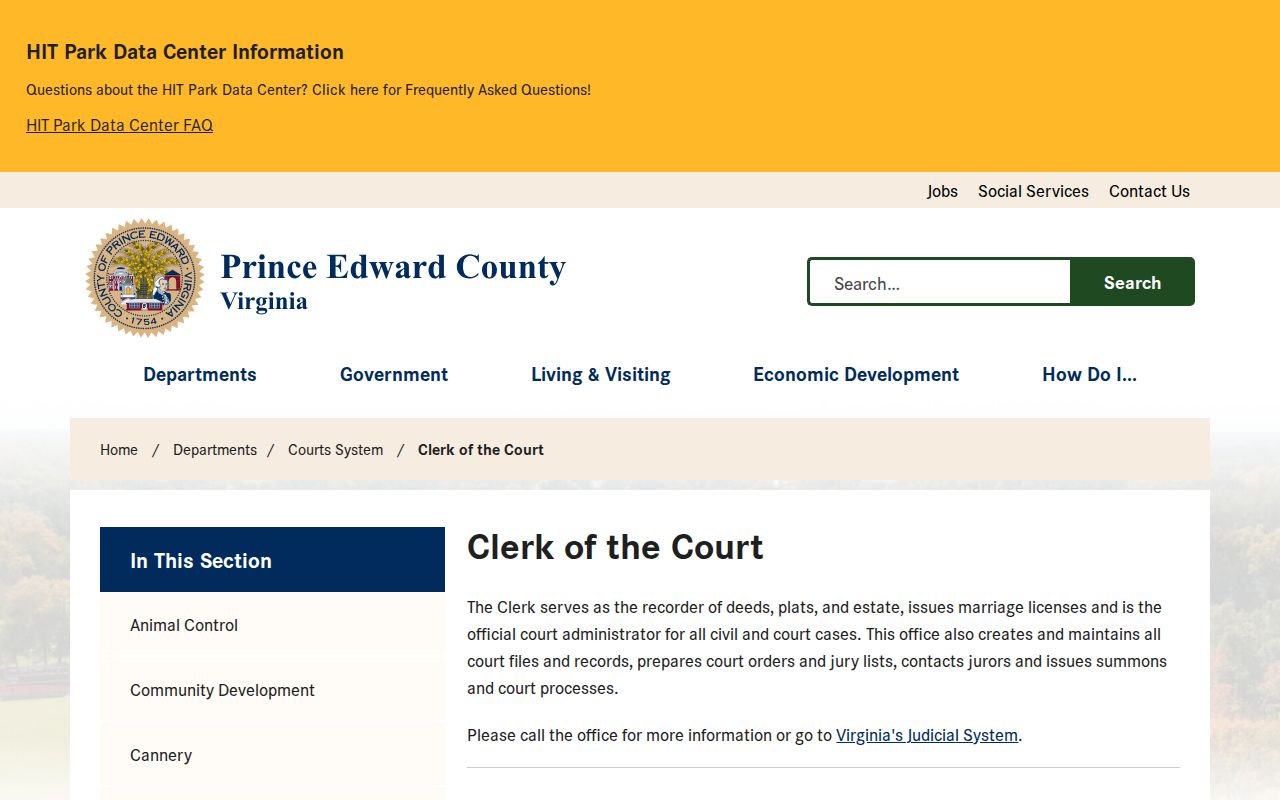
The Circuit Court Clerk's coverage page states the current online limits, and its historic cutoff marks the handoff point to books and microfilm held elsewhere.
Keep your index citation even when remote image access is blocked. The Clerk can take the parties, date, and book or document reference and locate a copy directly.
Using Virginia SRA for Prince Edward County
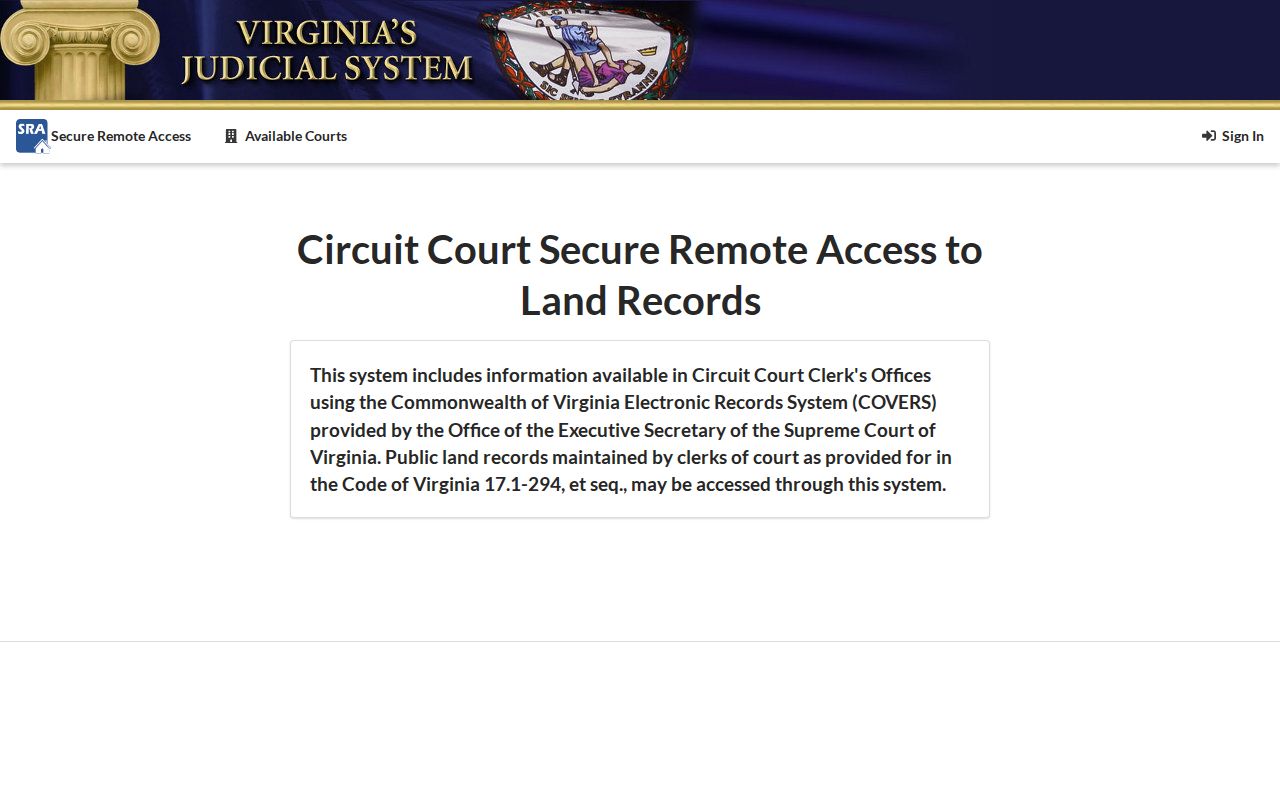
Virginia SRA is the remote land-record route the Prince Edward Clerk links for deed research. Select a locality first. Nothing searches until you do.
State guidance allows the Clerk to enable free index-only access. Image viewing is different. It is limited to subscribers the individual Clerk authorizes. Those subscribers act under an agreement and an applicable fee. An SRA result is an index aid, never the official instrument itself.
Search the party names and a reasonable date range. Then save whatever citation the result supplies. Capture the locality and document number. Note the book and page, recording date, instrument type, grantor, and grantee. Only record a sale price or legal description if the result actually displays it. For a clear image, ask the Clerk about subscriber access. An in-person terminal or a copy request works too.
The Virginia SRA landing page explains the remote access route and the current sign-in terms.
An index-only result still narrows a counter or mail request to one instrument and recording period.
Walking the Prince Edward County Deed Index
A grantor conveys the interest. A grantee receives it. Walking a chain of title starts from a known owner or parcel. From there you locate the most recent deed naming that owner as grantee. Read the grantor and the prior deed reference on that instrument. Then search that earlier grantor as grantee to reach the next transfer back. Compare every legal description along the way. Acreage shifts and exceptions appear. Easements and reservations come and go. Adjoining lands change, and parcels split or combine between deeds. A name-only chain can wander onto a different tract. Someone with a similar name may own that tract.
- Choose Prince Edward County and search the grantee name for the relevant period.
- Record the instrument type, grantor, grantee, recording date, book/page or document number, and any prior reference.
- Inspect the deed text and compare its legal description with the parcel or plat.
- Search the grantor's earlier acquisition as grantee and repeat while the land description still matches.
- Grantor
- The party shown as conveying an interest in an instrument.
- Grantee
- The party shown as receiving that interest.
- Chain of title
- The ordered sequence of recorded conveyances tied to the same land.
- Book/page
- A volume and page reference; preserve any historic pagination as printed.
For a wider address and parcel route, start with the Prince Edward County property search, then bring the matching owner and GPIN back to the deed index.
Older Prince Edward County Deed Books
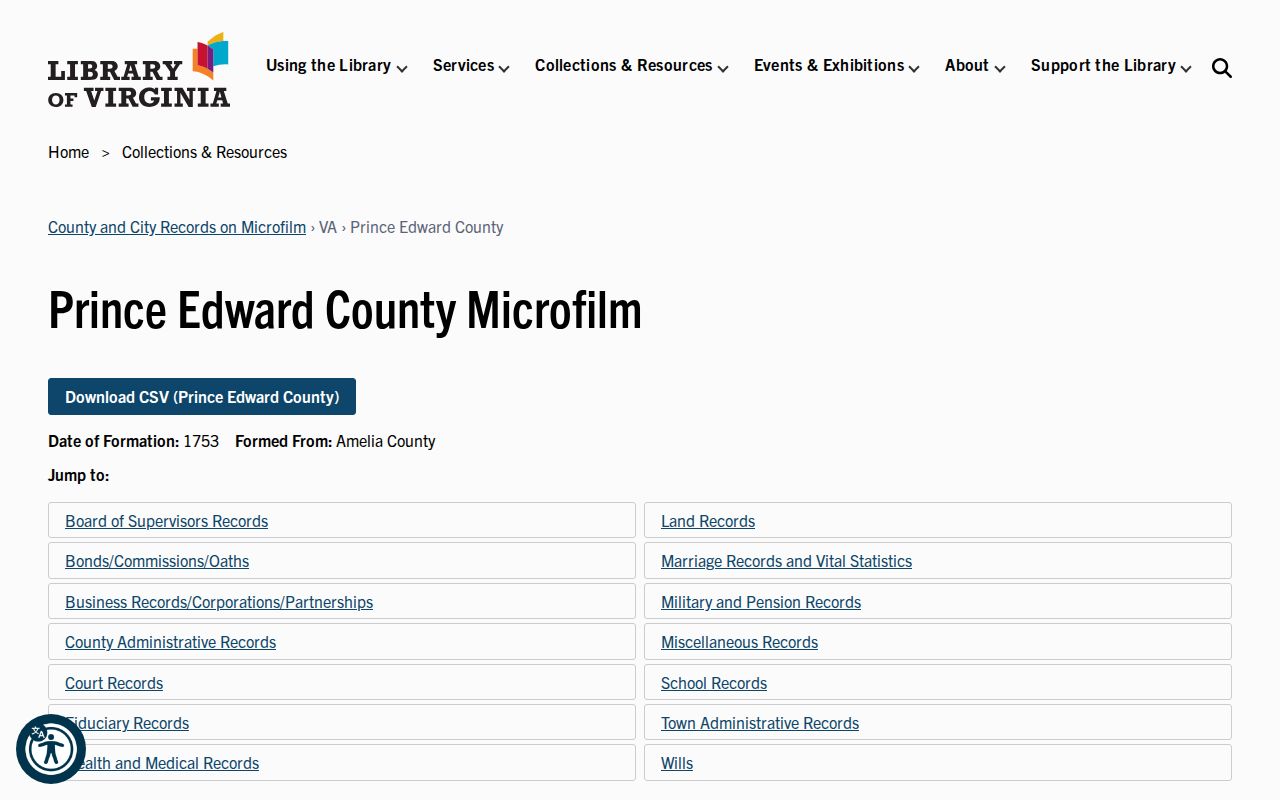
Prince Edward County formed from Amelia County in 1753. Its first deed book opens in 1754. The Library of Virginia catalog lists Book 1 covering 1754 through 1759, Books 2 and 3 running through 1771, Books 4 through 19 spanning 1771 to 1828, Books 20 through 28 covering 1828 to 1866, and Books 29 through 47 reaching 1866 to 1902. Early volumes may use unpaged indexes or unusual page conventions. Note the reel, volume, surname range, and folio exactly as the finding aid presents them.
LVA also holds general grantee and grantor indexes for 1754 through 1916. It also keeps a District Court deed book series for 1789 to 1816. Many reels circulate through interlibrary loan. Begin with the Prince Edward County microfilm finding aid. If no scan exists, request the reel. Or ask the Clerk whether the older book sits in the local vault.
Books and indexes can push a Prince Edward County land trail well past the modern online index. Assessing the continuity of title, though, still takes a separate review.
Prince Edward County Deed References
A Prince Edward County deed book holds more than deeds. Land records include many instruments. These include deeds of trust, assignments, releases, easements, road agreements, restrictions, judgments, lis pendens, financing statements, and certificates of satisfaction. Each instrument answers a different question. A deed transfers ownership. A deed of trust secures a debt. An easement grants a use across land, and a release records a later event. Read the names, the legal description, the dates, and any later references rather than treating every entry as a sale.
VADeed Alert offers a free alternative. The Clerk-linked service sends notices of land-record activity. These match a name or a Tax Map/Parcel ID. It looks forward only. It will not rebuild older history or replace reading the recorded deed itself. Anyone checking for a title claim should search judgments and court files alongside deed records. No county deed index can prove that no unrecorded claim exists.
Prince Edward County Court Records
Some Prince Edward County court cases change ownership without ever resembling a sale. A quiet-title dispute, a partition, a foreclosure, or a judgment can all affect a parcel. Search the deed index first for recorded instruments. Then contact the Circuit Court Clerk about the civil or chancery file. Ask there for the parties and the land description. Virginia's SRA system is land-record oriented. Case searches may take a direct inquiry.
Chancery records reward the effort. A decree, plat, will, notice, or deed can sit inside a case file. It can explain why land changed hands. Prince Edward causes run from 1754 through 1953. Digital images cover the years through 1913. Later unindexed material may need a request to the Clerk or Archives Research Services. Include the case number, parties, year, parcel, and the specific file or order sought.
Requesting a Prince Edward County Deed Copy
No image online? The Circuit Court Clerk can still provide the deed. Visit the first floor at 111 South Street in Farmville, or call 434-392-5145 during weekday office hours. A mail request can go to P.O. Box 304, Farmville, VA 23901. Include the parties as recorded, the document type, and the approximate date. Add the property address or legal description, the GPIN if known, and any book/page or instrument number. Ask whether the item sits locally, in Archives, on microfilm, or at the public terminal.
The Clerk publishes no copy-fee schedule or email request procedure online. So ask first. Confirm the current price, payment method, and pickup or mail options, and whether a plain or certified copy is available, before sending any payment. A request should seek an instrument. It should not ask the Clerk to certify title or name the "true owner." The image and its recording citation are the deed records worth reviewing.
Recorded, not guaranteed. A Prince Edward County deed entry reports an instrument of record; it does not prove that every interest is clear or that the legal description matches a fence line. Use a title professional for a title opinion and a licensed surveyor for a boundary dispute.