
Starting Prince Edward County Property Records
Begin with a public property search to pin down the parcel. Once you have a GPIN, the offices sort themselves out. The Commissioner of the Revenue keeps the assessment card and the owner of record. The Treasurer handles tax accounts and payments. The Clerk records deeds and plats. Each system answers a different question. A tax balance is not proof of title. A deed index is not a current appraisal card. A map label will not settle a legal boundary. Write down the GPIN and any deed book and page citation before switching portals, so every office can pull up the same land.
The county's e-Commissioner service opens the assessor side of the property record, naming the public system in its landing frame while live search fields load inside the portal. Open the Prince Edward County e-Commissioner portal to start a parcel lookup.
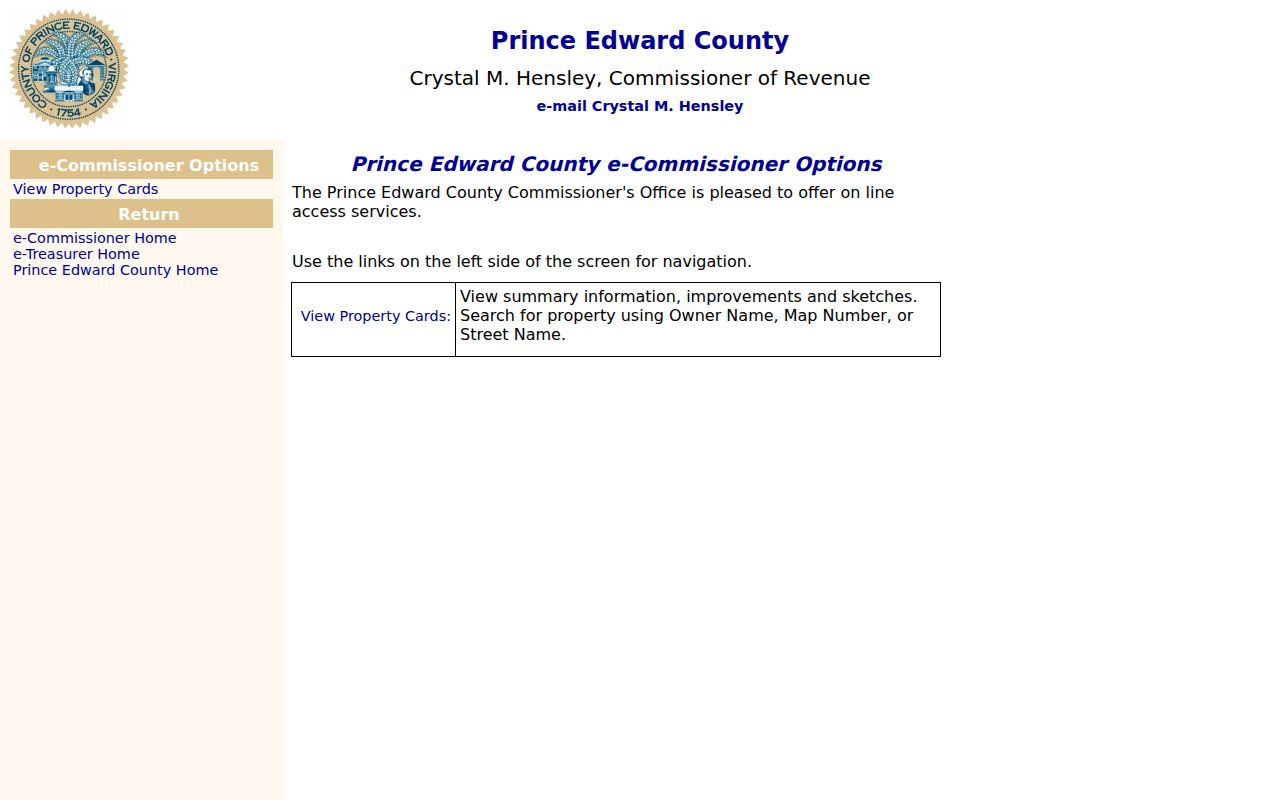
A static view of the public frame will not show every field. Treat it as a route marker. Run the live portal for the current parcel result. Then confirm any recent transfer against the Clerk's recorded instrument.
A property search usually starts with a street address. It can also start with a known owner or a GPIN from a tax bill. The county's Real Estate Records link leads to the Commissioner's ownership and assessment record. The Treasurer system covers the bill, payment history, and calculated balance. Virginia Secure Remote Access indexes the Clerk's land records. County GIS orients the parcel and its corporate-limit context. Each source holds one piece of the trail. Note which office supplied each fact.
Farmville makes jurisdiction a first question. The town crosses the Appomattox River into Cumberland County. A Farmville mailing address or ZIP proves nothing about which county's records apply. Confirm the county in the deed or on the map first. Keep the GPIN and legal description beside the address after that. A record search can identify recorded facts. It is not a title opinion or a survey.
- Write down the address, owner surname if known, parcel number, approximate deed year, and the question you need answered.
- Locate the real-estate account and record the owner field, GPIN, assessment year, and legal description when available.
- Search the newest deed by grantee and compare its legal description and prior deed reference.
- Review Treasurer billing data separately from the assessed value and deed consideration.
- Use GIS for spatial context, then obtain the recorded plat or deed if a line or easement matters.
When a live search hides a field or an image needs a subscription, save the citation and contact the custodian, whether Commissioner, Treasurer, Clerk, Planning office, or Library of Virginia. Each office holds one piece. Together they cover a full property history.
Prince Edward County Records Desks
Prince Edward County splits its property records across desks. The Circuit Court Clerk records deeds, plats, estate instruments, judgments, and related court materials. The Commissioner of the Revenue maintains the real-estate ownership roll and assessment information. The Treasurer takes taxes and answers bill questions. County GIS and Farmville GIS provide map layers. Planning holds zoning and subdivision material. Start with the office whose record answers the question rather than mailing one request everywhere.
Circuit Court Clerk
111 South Street, First Floor
Farmville, VA 23901
434-392-5145
Commissioner of the Revenue
124 N. Main Street, Second Floor
Farmville, VA 23901
434-392-3231
Planning and Community Development
111 N. South Street, Third Floor
Farmville, VA 23901
434-414-3037
Prince Edward County Online Deed Dates
The Clerk's local land-record page lists separate start dates for the index and the images. The online index begins January 1, 1916. Deed images begin January 1, 1940. Neither date marks the start of recordkeeping. Prince Edward deed books go back to 1754. Library of Virginia microfilm carries the older books and general indexes. An online search may find a party without an image, so save the citation. Ask about the counter, subscription, mail, or older books.
Virginia SRA may offer free index-only access when the Clerk enables it, though image access is subscriber controlled and authorized locally. The index identifies parties and dates, but the recorded instrument carries the legal description and conveyance terms.
| Index-only access | May be free when enabled; useful for party, date, and citation research. |
|---|---|
| Instrument image | Subscriber access is authorized by the local Clerk and may carry fees. |
| Counter or request | Use the Clerk when the image is unavailable or an older book is needed. |
Prince Edward County Farmville Address Checks
Farmville is a town and the county seat. Its limits cross the Appomattox into Cumberland County. A Farmville mailing address or ZIP 23901 does not put the parcel in Prince Edward County. Confirm the county first. Read it from the deed and the corporate-limit layers before choosing a Clerk, Commissioner, or Treasurer. A municipality may run its own GIS and permit systems even when the deed, ownership roll, and real-estate tax account stay with the county.
The town's GIS creates addresses for new structures and resolves local issues, while county E-911 Addressing maintains the county address database. Both help with a search key. The deed's legal description still rules.
Prince Edward County Tax Search Routes
The Treasurer's Real Estate Public Inquiry gives you three ways to pull a tax account. You can search by account number, GPIN, or street name. The account number sits at the upper left of the bill. The GPIN is the Tax Parcel ID#. Its spaces must be entered exactly as shown. Searching by street leaves off the house number. The results can run past a single page. A projected date field estimates penalty and interest. Left blank, the inquiry simply uses today's date.
From the selection screen you can flip between description and map number. You can then open payment history. That helps when you are pinning down a parcel somewhere along a block. It stops short of a legal adjacency list, though. Billing questions belong to the Treasurer's tax records. Ownership and the assessment roll live with the Commissioner instead.
Prince Edward County Record Types
A property records search in Prince Edward County can turn up many document types. Deeds, assessment cards, payment histories, parcel maps, permits, court orders, and archived books all surface under that umbrella. Each one exists for a distinct purpose, and each sits with a different custodian. Match the source to the question before treating any result as proof. A permit, for instance, documents an application or inspection event. A deed records a land interest. An assessment supplies a tax valuation for the parcel.
| Record Type | What It Documents | Kept By | Access |
|---|---|---|---|
| Deeds, plats, estates | Transfers, legal descriptions, lot maps, and fiduciary records | Circuit Court Clerk | SRA, counter, or focused request |
| Judgments and financing filings | Recorded claims and financing instruments | Circuit Court Clerk | Index access varies; images may require subscription |
| Ownership and assessment | County owner roll and assessed value | Commissioner of the Revenue | e-Commissioner link or office request |
| Tax bill and payments | Charges, due date, balance, and payment history | Treasurer | Real Estate Public Inquiry and counter |
| GIS parcels and permits | Map context, zoning, construction, and applications | County Planning or Town of Farmville | GIS viewers, Cloudpermit, staff, or hardcopy |
- Grantor
- The party conveying an interest in a recorded deed.
- Grantee
- The party receiving the interest shown in the instrument.
- GPIN
- The parcel identifier called Tax Parcel ID on the Treasurer bill.
- Plat
- A recorded map that can show lots, easements, and rights-of-way.
Reach for Prince Edward County deed records when the question is a transfer or a chain of title. Turn to the property tax records reference for a bill, a payment, or an appeal. A recorded plat controls lot geometry, while GIS serves as an index and orientation layer.
Prince Edward County's Historic Deed Trail
Prince Edward County was organized in 1754. So the earliest property research often leans on books and archival indexes rather than a modern parcel number. The Library of Virginia's county microfilm catalog lists deed books 1-47, covering 1754 through 1902. It also lists a general index spanning 1754 through 1916. That index range overlaps the start of the Clerk's modern online name index. It does not guarantee every older deed is digitized or searchable by today's parcel identifier. Trace a historic tract through the owner names and legal description recorded at the time. Then follow the citation into the right volume.
Chancery material helps when an estate, partition, boundary dispute, or title question reached court. The Library's Prince Edward collection runs through 1953, with online images available only through 1913. Later case entries may point to a file held at the archive or the court. Use these records to explain a chain. Rely on recorded conveyances for the actual transfer.
The county formed from Amelia in 1753, and its first deed book begins in 1754. Early volumes may be unpaged or use odd folio references. The Chancery Records Index adds land divisions, wills, plats, and family evidence for cases from 1754 through 1953. It covers those cases from 1754 through 1953. Digital images cover 1754 through 1913. This handoff lets an older search continue past the online index without inventing a gap.
When a chain gets difficult, save the prior reference cited in the modern deed. Then consult the LVA finding aid and the Clerk about the correct book or reel. Interlibrary loan covers many microfilm reels.
Prince Edward County GIS and Recorded Plats
Prince Edward County InteractiveGIS is handy for locating a parcel shape. It also shows a parcel's relation to a road and nearby features. The public landing page lists a September 22, 2025 data date. It states the maps are for reference. Recorded plats and deeds remain authoritative for legal acreage and ownership, per the county. Farmville GIS covers town parcels, structures, zoning, corporate limits, and more, with its own general-information disclaimer.
Use GIS to find the right map or GPIN. Read the deed or recorded plat when the boundary matters. A drawn line cannot settle an easement, right-of-way, or survey corner on the ground.
Prince Edward County Assessment, Bill, and Sale
Three offices and figures stay separate in Prince Edward County property records. The Commissioner maintains real-estate ownership and assessment records. The Treasurer handles tax bills and payment history. A deed may state consideration for a conveyance. The local online display was not confirmed. Assessed value is a taxation measure. Consideration is tied to a transaction. A tax bill is the amount charged for a tax period.
The county adopted a four-year general reassessment cycle. Still, boundary changes, divisions, zoning changes, court orders, and new construction can occur between reviews. Any of these can affect a parcel. The county's 2025 reassessment dates have passed. Use the current notice for an appeal schedule.
Farmville Property Records and Permits
Town permits and zoning can add a property-history clue. They do not change who records the deed in Farmville property records. Farmville uses Cloudpermit for building, demolition, trade, and community-development applications and inspection requests. Its checklist starts with a property address or parcel number if no address is assigned. Separate trade permits may apply. The building-page materials note a 24-hour minimum processing time. The applicant can be an owner, agent, or contractor. So the name alone proves nothing about ownership.
County Planning and Building hold separate county files. Ask whether a record is an application, permit, inspection, zoning decision, or recorded subdivision plat. Each answers a different question.
Prince Edward County Deed Alerts
The Prince Edward County Circuit Court Clerk offers a free email notice service. It is called VADeed Alert. It watches land-record activity for you. You can set it to match a name or a Tax Map/Parcel ID. When something new records against that match, the service sends a notice. It cannot review the instrument, stop fraud, or rebuild older deed records. Pair the alerts with regular checks of the recorded index. Ask the Clerk about current sign-up steps.
Treat every notice as a prompt, not proof. Verify it on the official Clerk page before answering any letter or payment demand. The document number, book and page, parties, and parcel context will identify the real instrument. A search result is not a title opinion.
Other Virginia Record Access
Some Virginia records help explain an entity, a court action, or an identity history. They are not land-title records. Federal cases live in PACER, not the county deed index. The Virginia voter lookup exposes only limited public information. The statewide registry and other protected data follow their own legal rules. None of it proves that a person owns or occupies a parcel in Prince Edward County.
For a federal claim or bankruptcy question, PACER is a separate federal court system. Run that search apart from the deed records.
Federal filings may connect to property due diligence, but the Prince Edward County land record remains a separate search.
Virginia Public Record Limits
Virginia FOIA covers public records held by public bodies, with exemptions. A good request names the custodian, the parcel or address, the record type, the date range, and the format you want. Staff may charge reasonable search, redaction, and copy fees. Ask for an estimate on a large request. FOIA cannot unseal a court file or set aside vital-record confidentiality rules.
The state election portal is a voter-service lookup, not a property owner directory. The sex-offender registry has its own statutory scope and cautions. Neither source establishes title. Virginia's Address Confidentiality Program can substitute a safe mailing address for protected participants in eligible public records.
Read the Virginia Department of Elections Citizen Portal description before relying on a search result.
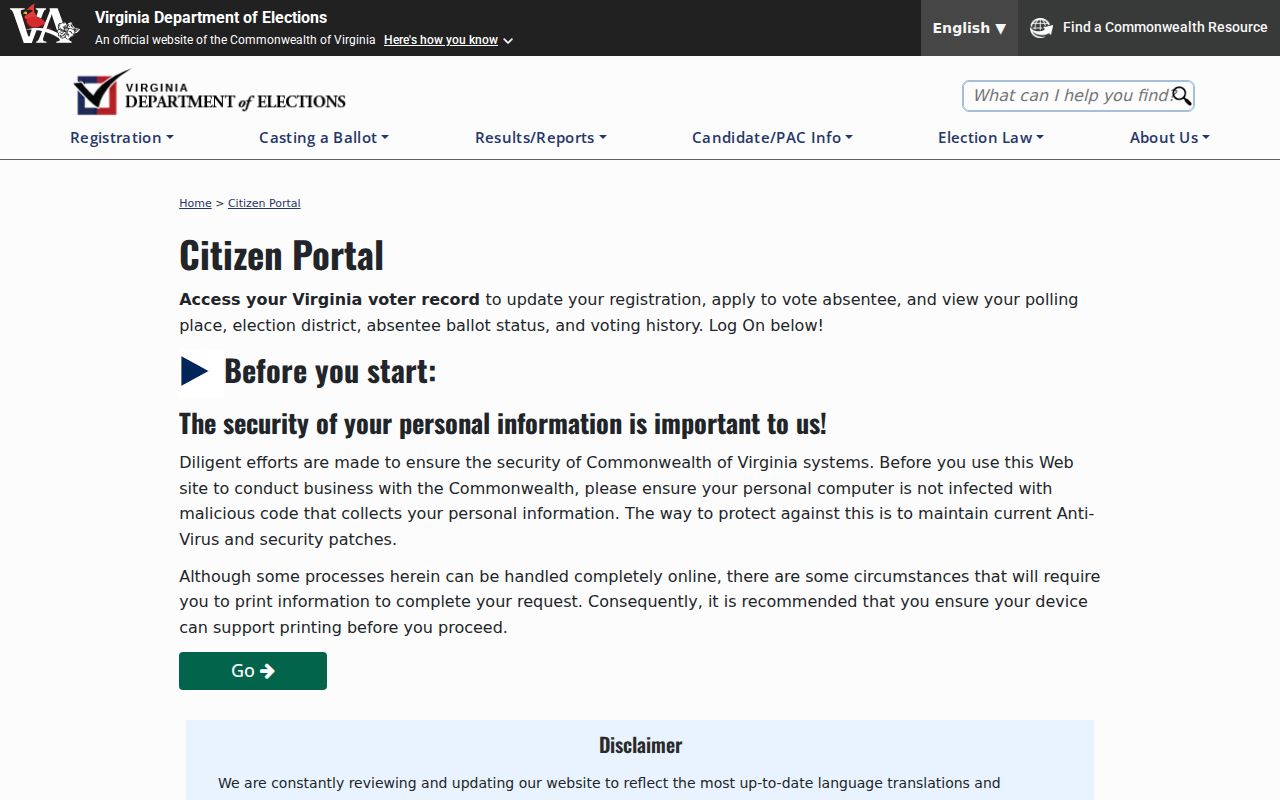
The portal is a separate state service. It does not replace the county ownership roll or the recorded deed in Prince Edward County.
The Virginia registry is governed by its own use notices.
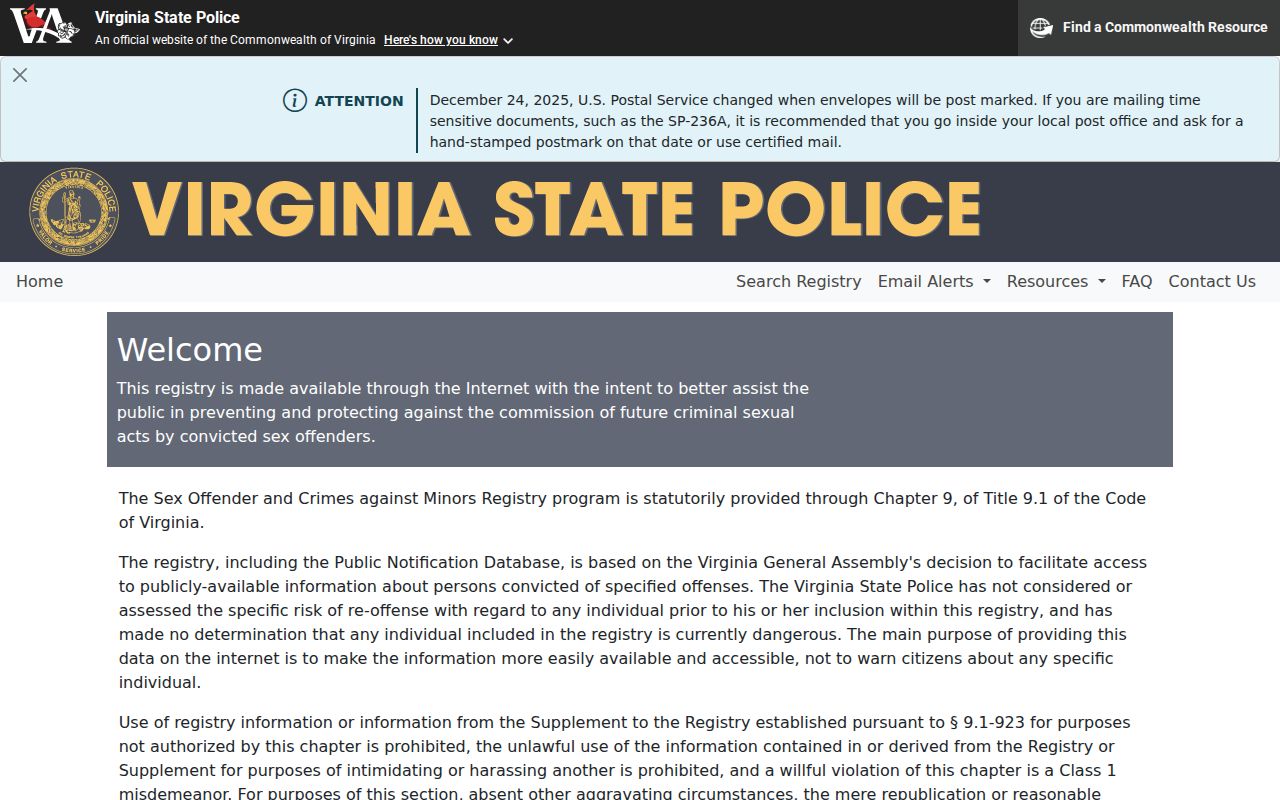
Registry entries are not property title records and belong only within the registry's official scope.
Limits of Prince Edward County Property Records
Prince Edward County records show what a custodian files and publishes: instruments, assessment entries, tax bills, and map layers. Gaps happen. Entries can lag, run incomplete, or resist matching after land is divided, combined, renamed, or passed through an estate. A GIS line is not a survey. A tax-roll name is not a title opinion. Match each record to its legal description, and take any important question to the office that holds the source record.
Lawful use. Use Prince Edward County property records for property diligence, civic research, house history, or an assessment question. Do not use a public record to stalk, threaten, or harass anyone.